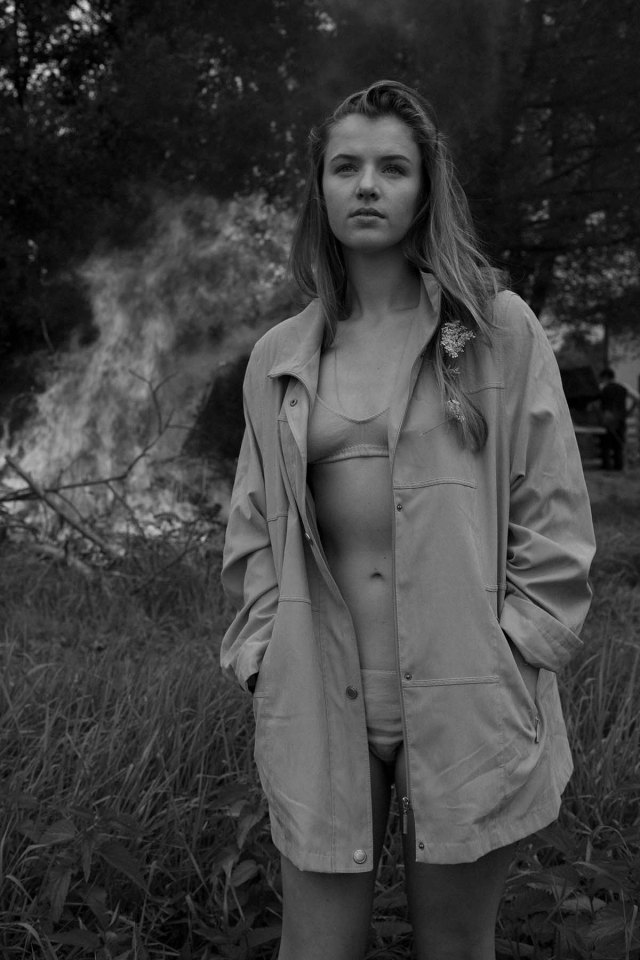
Julie Newton – Textile Artist

Textile Artist - Julie Newton

This week I spoke to textile artist, Julie Newton about natural dyeing, what items in your closet you take for granted, and why Ally and AJ should be protected at all costs.

Julie’s fashion journey began in high school when she began embroidering and personalizing the clothes she already had. She explains that as a beginner embroidery was attractive because “it’s a very accessible art form; you just need thread and a needle” to get started. Inspired by embroidery from the 50s and 60s, she experimented with thrifted clothes and eventually decided to pursue the textile arts as a career. After a brief stint at The University of British Columbia, she decided to enrol at Polimoda, a fashion school based in Florence, Italy. She says that there was a vast divide between her education at these two institutions; at UBC she was accustomed to one or two hour lectures, whereas Polimoda demanded ten-hour days of hands-on learning to simulate life on the job. A particularly tough class was knitwear, a class in which “you either learned really quickly or you were behind from thirty minutes in the first class”. Despite being a four-year program, Julie decided to leave Polimoda after two years, citing that “I really felt that I wanted to give it my go” back in Vancouver.

Prior to her studies at Polimoda, Julie had started her own company, Hijulez, when she was eighteen years old. This was a continuation of her love of embroidery that she had developed in high school, but began to involve more intricate and expansive work following her post-secondary studies. Julie describes her style as comfortable clothing with unique patterns, bright colours and natural dyeing; the latter becoming an area of focus over the last year and a half.

Natural Dyeing

With her background in fashion history, Julie notes that for the most part, people simply did not have access to most colours until the advent of synthetic dyes. That is not to say that civilizations lived in beige and grey, but rather that natural dyes were a major source to bring life into one’s clothing. Julie says that Vancouver affords her nearly limitless opportunities to experiment as “every month, something changes in Vancouver and there is something available” to try. She describes this process as a bit of a science experiment, combining different ingredients, bonding agents and fabrics to try and get her desired effect. Some ingredients she has sampled this year include cherry blossoms, magnolias, cedar, berries, sumac, and mint sage, many of which even came from her home garden. Julie began growing her garden at the onset of quarantine, and she says that this process has helped her become more patient with herself, citing that the fast-paced schedule that she pushes to maintain is forcibly balanced by the fixed growth cycles of her garden. This has also helped her localize the means of production for her items as she is able to source, sew and sell her products within a much smaller range.

Fast Fashion

When I asked Julie about what item of clothing most people take for granted, she said that a simple collared shirt could actually take up to five hours of continuous labour to produce. This discrepancy between perceived and actual labour is one of the reasons Julie had found it difficult at times to compete with the fast fashion industry. She says that the prices we have been accustomed to are relative to exploitative practices that go into the making of the clothing, while consequently making local goods seem overpriced in comparison. Julie’s upcoming launch of an intimates line has been directly affected by this dichotomy as she is trying to balance pricing, labour, and quantity in an effort to combat this issue.

Another issue she has faced is larger companies taking designs she has created and used them in their own products without any attribution or credit. Julie says that in fashion “there’s always inspiration, but there’s definitely blatant knockoffs” as well, and that it can be very disheartening to see her work gain traction under another name. But as a smaller company, she tries to maintain a balance between making efforts to protect her intellectual property and overextending herself and risking burnout.

Aly & AJ and other Happy Accidents

Inherent to creative experimentation is failure, and Julie says that she is lucky to achieve her original vision in half of the projects she attempts. While her success rate has increased over the five years of Hijulez, failure continues to be a part of her creative process. However, she embraces the positive aspect of failure, contrary to the definition that was presented to her in fashion school. Instead of viewing a project negatively if it doesn’t turn out as intended, she says that her career has in many ways progressed due to “lots of happy accidents”. (This, of course, excludes mistakes she has made in respect to not getting enough sleep, such as “sewing the wrong arm on something five times because you’re too tired”).

For Julie, the best part about being a textile artist is when she is able to connect with someone who shares the same aesthetic and values that are represented in her products. This can range from folks browsing her clothing in her driveway, collaborating on product launches with her friends, all the way up to much bigger clientele. One of the stores Julie sells her clothing in is One of a Few in Gastown. She has worked with this company for several years now, having been discovered on Instagram early in her career due to her embroidery work. Two of the many (get it?) visitors to One of a Few are Aly & AJ, a pair who are a pretty big deal for anyone, but an even bigger deal if you are like me and grew up in the early 2000s. Attracted to Julie’s work, Aly & AJ reached out to her on Instagram and began a chat that eventually led to Julie designing their tour merch and drum kit.

To end this article, I thought it was important to mention that Julie’s passion for sewing is much more than skin-deep. She shared a story from when she was six years old and camping with her family. Upon her dad (who is an ER doctor) accidentally cutting a deep gash in his hand, she was tasked with suturing the wound so they could get to a hospital. After a passable suture job, she remembers thinking “great, let’s do this on fabric. Or anything else,” which if nothing else shows the drive and perseverance that has got her to where she is today.

For more on Julie and her work, check her out on her website and on Instagram.

Follow A Musing on Facebook and Instagram for more content on Julie and the other creatives in this series.

And don’t forget to read about podcaster Jake Robins.

-BF

Dide Su Bilgin – Writer & Director

Dide Su Bilgin - Wrier & Director

This week I spoke with writer and director, Dide Su Bilgin about the influence of improv on her work, select projects from her filmography, and the upcoming release of her brand-new podcast.

Dide Su’s passion for filmmaking began at a young age when her parents bought her a stop-motion animation kit containing a simple camera. With these basic tools, she started filming stories showcasing the day-to-day lives of her toys, and this emphasis on character has followed her throughout her filmmaking career. Dide Su also moved around a lot during her childhood, living in Hungary, Turkey, Connecticut and San Diego before coming to Vancouver. A constant presence throughout these moves was what she described as her “travelling film Bible,” a set of binders filled with SNL DVDs indicative of her love for comedy. I’ve only ever moved across Vancouver, and even I can sympathize that weight matters in a move; individual DVD cases simply did not make the cut and therefore necessitated the binders.

Improvisation in Filmmaking

As university approached, Dide Su debated whether she wanted to study animation, design or one of several other creative pursuits. Eventually, she came to the realization that filmmaking afforded her the opportunity to combine all of these interests into one. While studying Film Production at The University of British Columbia, she successfully auditioned for the UBC Improv team and continued a passion that she had developed late in high school. While she said that joining the improv team was a great experience in its own right, it also gave her several skills that she was able to translate into her directorial work. At first glance, the structured schedule of filmmaking and the freeform landscape of improv may not offer many obvious parallels. However, Dide Su says that there are always opportunities for spontaneity and experimentation in filmmaking, but it is often up to the director to take advantage of these moments. She says the takes where she momentarily veers away from the shot list are often the takes that prove most valuable once filming is completed. Having more options to choose from in the editing room can be a luxury and grant her more flexibility to effectively shape the narrative.

Finally, Dide Su has found that “the false confidence that improv provides you is key,” when trying to navigate the inevitable hiccups presented to her as a director. The many moving parts on a film production can bring “a level of excitement you might need to tone down or focus,” and Dide Su says her time in improv has helped her massively in this regard.

Select Directorial Projects: Plain Jane and “Too Good”

Dide Su made her directorial debut in university with a self-written film titled, Plain Jane. In addition to Film Production, she studied Cognitive Science, and this had a large influence on the inspiration behind this film. While learning about the various forms of amnesia she was inspired to write a script starring a hoarder who finds herself in a hospital. With her script in hand, Dide Su remembers bringing it to class with confidence but subsequently feeling devastated upon receiving a heavy critique. Elaborating on taking criticism as a creative, she says that feedback is always good, and “a lot of understanding criticism in your own work is understanding biases that you’ve had for a long time”. However, she says that creatives also have to acknowledge that you can’t please everybody and that the external reception of your work will often be out of your control. The most important lesson she took away from this experience is learning to prioritize addressing what is in her control, saying that “if you’re not happy with it, then it’s important that you alter it”.

Moving from her first directing gig to one of her most recent projects, Dide Su recently shot a music video with Haley Blais, for her song, “Too Good”. From their first meeting, Dide Su was excited to collaborate with another artist who already had a loose idea of where she wanted to take the video. She describes this process as a “moulding of minds” to build a story around Haley’s original concept of a beauty queen running away from her contest. The video was shot handheld in the earliest stages of COVID-19 hitting Vancouver, which created a great juxtaposition between the prom dress Haley was wearing and the backdrop of a “weird dystopian downtown Vancouver”.

One scene that stood out to Dide Su was the closing scene in which Haley runs on the beach into the low tide, eventually disappearing in the distance. In the pre-production planning, Dide Su had intended to include a shot at low tide, but she didn’t expect to be able to do it given the shooting schedule and projected weather patterns. But on the day of shooting, a low tide presented itself and given the handheld nature of the shoot, they were able to quickly capitalize on the moment. Once Haley began running into the tide, Dide Su says that her experience in improv kicked in and they continued to roll as Haley ran further and further away from the camera. Dide Su describes this as “one of the greatest moments” of this shoot, having the ability to be spontaneous and capture what proved to be a key feature in the video.

Speaking on the differences between shooting music videos and films, Dide Su describes music videos as great exercises to improve her filmmaking as a whole. She says that to clearly communicate a narrative in such a short amount of time, “you really have to convey it in the most efficient way possible, or leave it abstract” to capture the feeling of the song. This particular shoot helped Dide Su break out of a writing slump she was in, and focus all her efforts into telling a simple story within these constraints. She also comments on the teamwork needed for filmmaking in general, saying that “there’s something really comforting” about tackling such a big project with every individual cast and crew member moving towards a common goal.

Writing for Films… and Podcasts?

As a writer, Dide Su has never written for anyone else, describing her writing style as clear to her but perhaps less so for another director. Another obstacle is that she thinks that it would be very difficult to hand over a script, remove herself from the shoot, and not be “that writer on set… like two inches away from being in the frame”. We’ve all seen Dance Moms. Dide Su has always enjoyed writing character-heavy scripts, and she attributes this in part to creating characters on the fly in improv. But much like improv, one of the greatest difficulties she encounters as a writer is identifying the point at which to end a scene. She says that she can find herself overindulging in a scene when she is enjoying what she is writing, and passing over the right beat to end the moment and progress in the story. Despite her passion for her work, Dide Su also stresses the importance of not letting filmmaking consume her life, explaining that “if you don’t live life, what are you going to write about?”. The answer to this question is how we have six Transformers movies.

During this downtime for the film industry, Dide Su has found herself pivoting her writing towards her own cultural identity to bring attention to Turkish cinema and female directors. Another endeavour is the launch of her very own podcast, Blood In The Water. In this podcast, she interviews guests about the hot-button topic they cannot pull themselves away from in a conversation. The first episodes of Blood In the Water cover service animals, fast food chains and Norwegian black metal, which coincidentally all share the same tier on Maslow’s hierarchy of needs. Stay tuned for its release, and I’ll be sure to share it when it comes out.

According to Dide Su, the common thread in all her experience as a director has been the joy of meeting “people who are so excited about making films, telling stories, and trying something new”. If this sounds like you, follow Dide Su on Instagram and check out her website to see more of her work. If you missed it before, also check out the music video for “Too Good” by Haley Blais.

Follow A Musing on Facebook and Instagram for more content on Dide Su and the other creatives in this series.

And lastly check out last week’s article with comedian, Maddy Kelly.

-BF

Sofia Shamsunahar – Doodle Artist

Photo by Bronwyn Davies

This week I spoke with Sofia Shamsunahar, a self-titled doodle artist, and newly minted comic book artist. We spoke about learning to enjoy life’s mistakes, her evolution as an artist and the release of her upcoming book.

Art as Self-Care

Sofia took art classes throughout all levels of high school, but her passion did not initially translate to academic success. She told me how she used to consider only classical, realistic paintings to be “true” art, and relegated her doodles to the margins of her homework. This inner division resulted in diminishing grades in art class, and she admits she was barely passing until her teacher accidentally graded one of her doodles. Granting her an A on the fortuitous submission, her teacher said “Sofia, I think you’re on to something with these doodles,” complimenting her simple and imperfect linework. Sofia cites this as the point at which she began investing more time into her art, and when she started to consider that her doodles may hold some artistic value of their own.

In her third year of studies at The University of British Columbia, Sofia encountered difficulties in her personal life and returned to doodling “as a form of self-care”. During this period of her life, she says that “drawing made me feel really good… I had the power to make something when I just felt like, you know, really small”. Posting a series of doodles and stories from this time on Instagram, her followers responded overwhelmingly positively to both her art and her message of mental health advocacy. From a desire to continue to help others through their own trials, Sofia began posting her art more often with “the intention that people would reflect [on] their well-being”. Producing regular content resulted in an increased following on Instagram and spurred Sofia to explore more artistic avenues. She won a competition to paint a mural on a bike cage at UBC and was soon approached for more engagements across campus. These included commissions to paint murals on university grounds on behalf of several student organizations, and weekly gigs drawing live portraits alongside live music. While some commissions came as a result of the organization’s values aligning with the messages in Sofia’s doodles, some came simply from fans of her artistic style. Sofia also was invited to speak to other students about the intersection between her art and her own vulnerability; articulating the use of art as self-care.

The culmination of her artistic arc at UBC is an upcoming feature in a documentary series on local change-makers. Over the course of filming, she visited all of the locations on campus that helped shape her journey including the murals and wellness services that she had engaged with. She said this was a great opportunity to “step back and see all that I had done at UBC,” as well as a humbling moment to recognize the acclaim her art has received. I’ll be sure to share it when it is available.

The Art of Making Mistakes

The acknowledgement of vulnerability and life’s hiccups in Sofia’s art is also tangibly reflected in her personal style. Sofia says that “I don’t mind making mistakes,” and leaves scratched-out misspellings or misaligned lines in her doodles to support this notion. Moreover, this license to make mistakes allows her to “capture all your feelings in the moment” without overthinking or overplanning. The subject matter in her doodles has varied over the last three years, but animals have remained a consistent theme in her art. She says that this harkens back to what she drew when she was younger and is a reflection of her desire to keep her inner-child alive. Animals were frequent guests on her homework doodles, but the challenge of simplifying their anatomy keeps this subject matter fresh. As for the stories behind her doodles, Sofia says that the inspiration usually stems from learnings reflecting on her own personal development. Starting with this prompt, she moves to determine what subjects best symbolize the story. She says that her art has recently evolved to become more story-driven, incorporate more text and categorically now might be more akin to a comic than a doodle. Even though she has refined her style since she began, she still celebrates how “there’s some beauty with how imperfect it is”. This line is coincidentally also how I introduce myself on first dates.

After graduating from university Sofia travelled through Malaysia, Vietnam and Taiwan, documenting her time through her doodles without any definite intention on what to do with them. Upon her return, she emailed a general manager of a publishing company that she had found through a mutual connection. Sofia says she didn’t necessarily expect a reply, let alone a reply in less than an hour expressing interest in publishing a series of books based on her art. She said she feels extremely grateful for this opportunity, and is still surprised that her art has garnered such interest. Progress in production has been halted due to COVID-19, but her first book will be titled simply, Sof’s Doodles. In this book, she will compile stories from her recent travels along with the themes of finding balance and learning how to be happy with herself. She admits that some artists do not value her doodles as much as “traditional” art, and this has been a bit frustrating when networking with other creatives. To them, I ask where is your publishing deal?

Reflecting on the last few years, Sofia said that “I still can’t wrap my head around it. Like for me, it’s just a fun thing I do on homework, you know”. Mental health advocacy continues to be a core tenet of her work and she continues to find great value in connecting with individuals who relate to her doodles. Making meaningful connections with likeminded individuals has been an unintended, but welcome aspect of her doodles; growing her platform for both her message and her art. For more on Sofia, follow her on Instagram and check out her website to see upcoming work and the backlog of her portfolio.

Remember to follow A Musing on Facebook and Instagram for more content on Sofia, and the other creatives in this series.

And check out last week’s interview with sketch comedian, Kevin Saxby.

-BF

Corim de Guzman – Filmmaker

This week I spoke with Corim de Guzman, a filmmaker and Youtuber who has amassed an amazing portfolio of work. We spoke about the coolest project he’s done, some hot work he turned down, and how to avoid burnout as a creative.

Corim’s journey as a filmmaker began like many others, making home movies of family vacations and documenting his personal life. After becoming comfortable with a camera, he began to make original narratives and won his first accolade with a venture into stop-motion animation. Taking inspiration from a video he found on Youtube, he created a stop-motion video in which he fought… an office chair. Thanks to this video, he won his middle-school talent show and kickstarted his career as a filmmaker. The chair was unavailable to comment.

After Corim began his studies at The University of British Columbia, he reached out to student organizations to offer his services and gain some more experience. This initiative resulted in his first paid gig as a filmmaker when he was hired to film “UBC Homecoming” in support of varsity football. Running through the 10,000 person crowd, he describes this experience as “action-packed” and “overwhelming” to take on by himself. At the time, this was one of the largest undertakings of his career and he spoke about the pressure to deliver on such a big stage. But once his final cut was published, he was rewarded with an influx of commissions from other organizations seeking his talent. Corim says that the adrenaline from the crowd and the physical challenges presented by event filmmaking are what first attracted him to the genre and what keeps him returning for more. Furthermore, he tells me that the creative freedom he has in event filmmaking is unlike any other. He says that “nothing is too crazy when it comes to event filmmaking,” and that these limitless possibilities push him creatively to constantly explore new shots, effects and styles.

Castles to Cars: Diversity in Filmmaking

In Corim’s opinion, the best part of freelance filmmaking is the “diversity of the people you meet” and the experiences you are exposed to. This diversity is celebrated in his portfolio that spans incredible locations, genres and clients. Corim first explored filmmaking through travel videos, so it is no surprise that one of the first goals he set for himself was to be paid to travel as a filmmaker. The first assignment in which he accomplished this was when he was asked to film the Ice Castles in Edmonton, a collection of life-sized castles sculpted entirely by hand out of ice. Between spending his childhood in the Philippines and studies in Vancouver, he had never experienced this degree (or lack thereof) of temperature before. When I asked him about these working conditions he remembers thinking “what am I getting myself into” as the sprinklers that created the ice froze his clothes against his body. However, he described the final products as “straight out of Disney” and looks back at this experience as a major checkpoint in his filmmaking journey.

Moving to his more recent work, Corim discussed a commercial he just shot for Porsche. When selecting clients, he tries to choose work that he is passionate about, but naturally, sometimes creative compromises have to be made. What made this shoot memorable and unusual for Corim was the creative liberty he had to experiment and “get away from the usual style” of corporate filmmaking. This freedom made this project feel less like a corporate gig and something in which he could really inject his personal style. In addition, this was the first professional project in which he worked alongside his brother, making the job that much more special. Over his career, Corim has “taken on any kind of project [he] can get his hands on in any type of industry,” and this has led him to accumulate an extremely varied roster of clients. However, there are exceptions to any rule, and he shared a few would-be clients that stood out over the last 5 years.

One such client found Corim’s work on Instagram, like many before and many since then. Impressed by his page, the client sent Corim a standard inquiry message that also included the key phrase, “I was wondering if you’d be interested in shooting porn”. Corim described this as the most “outlandish” project he has ever been approached for, and for the record, he said no. While this project was unique in the subject matter, Corim tells me that the payment can be equally surprising. He shared another message in which he was asked to shoot a standard product video, but instead of a cheque, the client offered payment in the form of magic mushrooms. I do not know what the current exchange rate is for video content to mushrooms, but this was another project that Corim politely declined.

Be Nice and other Career Advice

As a self-identified workaholic, Corim notes that many creatives face burnout and that this is “something that more people should be talking about”. Between late nights and fast turnarounds, filmmaking can easily have a negative effect on one’s mental health. To avoid burnout, Corim tries to find a balance between the amount of corporate work he does and his own passion projects. In between shoots, he also tries to make sure he does “activities that have nothing to do with filmmaking” to give himself a mental reprieve. Moreover, his advice to creatives is to “surround yourself with the best,” to stay happy, healthy, and produce the best work.

On one such non-filmmaking excursion, Corim found himself downtown at Twelve West to celebrate a friend’s birthday. In a state that he described as “a little bit hammered,” he struck up a conversation with a man at the bar. After exchanging Instagram handles, Corim continued on with his night, not knowing that his bar companion was one of the marketing leads at Vessi. This chat eventually led to a healthy partnership with Vessi that Corim maintains to this day. Early on in this partnership, Corim pitched a shoot to feature their products in Hawaii. Vessi initially declined the offer, so Corim gathered some friends with the intent to travel on their own. But on the day before the flight, Corim received an update that Vessi had reconsidered and was now interested in sponsoring the shoot. (If you’re thinking of upgrading your Crocs this summer, check out the final cut). Much like the Ice Castles were a milestone in Corim’s journey, this shoot represented the next step as this was his first sponsored international shoot. Looking back at the humble beginnings of this partnership, Corim says that “the moral of the story is you never know who you’re going to meet, so be nice to everyone”. If all drunk people would heed this advice, the world would be a much better, and probably less sweaty place.

Youtube

Corim’s most recent endeavour is his journey into Youtube. He tells me that this has long been a goal of his, but he had always faced “that hurdle of putting yourself out there,” and to come out from behind the camera. He’s not entirely sure what his channel will look like but “a mix of tutorials, vlogs,” long-form narratives or documentaries are all possibilities. He has already released some great content, so definitely check out his channel for more. To stay updated with Corim’s work, or to proposition him for questionable gigs, make sure to shoot him a follow on Instagram as well.

If you liked this article, give the page a follow on Facebook and Instagram for bonus content!

And in case you missed last week’s article here you go!

-BF

Skye Portman – Photographer

This week I’m talking to Skye Portman, a talented photographer and creator of one of my favourite photo series, A Day in the Laugh. We had a great chat about photography, comedy, pies, and strippers. Intrigued? Let’s go.

Cover(ing) Bands

Skye began photography back in her hometown of Derby in the UK, a town in which her estimation is best “known for pies, ales, and drugs”. I do love a nice pie, colour me interested in a post-isolation trip across the pond. She was fifteen years old when she booked her first gigs to photograph bands at a local bar, the Victoria Inn. Equipped with a “really bad Sony Cybershot,” and business cards she had handwritten on pieces of paper, she eventually carved herself out a regular gig. What was your excuse for not starting your project again? You don’t have the right paint yet? Right. Anyway, Skye tells me that this job was a great opportunity to gain real-world experience as well as meet an incredibly varied cast of characters both on and off-stage. From Jack Black from Tenacious D or Dave Grohl from two pretty good bands, Skye has amassed an impressive network over her career. However, the standout moments from this gig were not when she met these household names. For Skye, the moment when she felt that she had made it as a photographer was when travelling bands “gave me their t-shirt for free”. If UK concert merch prices are anything like the ones here in Vancouver, I’d consider those gestures a major perk as well.

Another interesting period from Skye’s time at the Victoria Inn was photographing “replica” bands, “like the fake The Who and the fake Blondie”. Where the amateur photographer would see just another gig, Skye saw a major marketing opportunity. After each show, she realized she had “all these amazing photos of people who kind of look like the doppelgangers” of the original bands. Taking this footage and putting it up on her website was a great way to gain some clicks from potential clients. Skye diplomatically told me that when people saw these photos and thought they were celebrities, “technically they’re right, but technically they’re wrong too so I leave it to their imagination”. Entrepreneurship at its finest.

A Day in the Laugh

After moving to Vancouver, Skye began working at The Brett Martin Show where she was introduced to local comedians and other members of the stand-up community. She quickly realized that “people weren’t photographing comedians,” with video or audio content being the popular choices. Sensing an opportunity to help fill this void, she began brainstorming the framework for what would become a project she continues through today. For the format, she took inspiration from an assignment she had in university in which she was tasked to photograph a market at opening, during operating hours and after closing. Adjusting this to fit a comedian’s schedule, Skye began photographing comedians before, during, and after a show. As for the name, she admits that she had difficulty coming up with a good tag, and credits her friend Rich for coining “A Day in the Laugh”. Skye explains that the reason why she chose this format was that prior to working with comics, her “perception was comedians go to a show, they do their bit and then they go home”. But after meeting so many comedians and watching their individual processes, she thought that each comedian’s unique arc of a show night was something worth sharing.

When I asked her to share her most memorable moments from this project, it was hard for her to single out anyone in particular. She credits Chris Griffin for being the first member in her series, as well as Sasha Mark who she describes as an “absolute babe” to work with. She also shared a story of photographing Dion Arnold at The Penthouse, as she had “never been to a strip club…In Vancouver”. Skye tells me that after his set was over they “went down one level and [Dion] goes, “Do you wanna see strippers?” Skye made the same rational decision any of us would make, but after a brief moment, both Dion and herself agreed that just a quick glance would do. This is just one example of the wide variance in venues, shows, and of course the comedians themselves that Skye has captured in this project. She says that “no two have been the same, and that’s been the fun and joy of it, the authenticity” of each performer she has worked with. A Day in the Laugh is now in its second year of production, with features on nearly 50 comedians, improvisers, sketch performers, and all-around funny people.

Photography

When I asked her what she found most difficult about photography, Skye shared her mixed feelings towards Instagram. One one hand, she cites Instagram as a useful tool for her to conduct research and get inspired by other artists. However, she cautioned that “the photograph can lie,” upon first glance. She expressed her frustration towards “kids on Instagram who are photographing these staged lives and pretending that they’re incredibly happy when deep down they’re dying inside because they just need those likes to feel glorified”. Other difficulties she shared include the inescapable late nights of both music and comedy photography, along with the nerves she still feels before every shoot. However, she doesn’t dwell on the negatives and instead reframes these struggles as opportunities for growth. She states that “even though the worst parts really are terrible it pushes your boundaries” to become a better photographer. Moreover, “if you weren’t challenged, you’d stay exactly where you are”.

Returning to how we began our conversation, I asked Skye about what were the major similarities and differences between photographing bands and photographing comedians, Skye says that while both subjects are similar in that she is capturing a performance, she feels that with a comedian, “it’s more on a personal level”. She shares that this level of intimacy was not always present when she worked with musicians, adding that what drives her passion for photography is not necessarily the subject matter, but rather the subject itself. In her words, “I like to learn about people, I want to understand people,” and this is one of the reasons she has found a home photographing comedy.

I’ll end with some words Skye shared when I asked where she finds inspiration for her photography. She said that to get inspired, “absorb everything, take it all in,” and that we can find exciting ideas in ordinary circumstances. As we loosen social isolation, I feel like this advice rings more true than ever as the little things we took for granted will feel so much more exciting than ever before. For more on Skye, check out her website to see the entire backlog of her work. To keep up with A Day in the Laugh shoot her a follow, and if this leaves you begging for more, give Skye a follow as well. Thanks again to Skye for the chat, stay safe out there everybody, and we’ll see you next week!

-BF

Check out last week’s article with Colin Williams!

Colin Williams – Filmmaker & Writer

Colin on the set of Methodic.

For my first external feature, I had a chat with Colin Williams, a man who wears many hats including filmmaker, writer, music producer, and black baseball cap wearer. This is our chat about our common beginnings, his entry into filmmaking, and what exciting adventures lie ahead.

Beginning our conversation, we discussed our shared history of acting as our gateway into the performing acts. Colin made the choice to pursue acting at The University of Victoria after developing this passion throughout high school. One of the catalysts in his pursuit of acting was a successful role as Grigory in Chekhov’s The Bear, but he admits that the connection he felt to this character was not always present with others. In his words, Colin began writing to solve this problem and create “characters that I found interesting, that I would want to act in”. This progressed into spending more time writing than acting, as well as a growing interest in filmmaking as a whole. He said he “wanted to learn the whole process” in order to create his own opportunities, and gain the control to produce his own work. From there, moving behind the camera was a natural, but by no means given progression.

The Ups and Downs of Filmmaking

To pursue filmmaking Colin left Victoria and headed to Vancouver to enroll at The University of British Columbia. The culmination of his degree in Film Production was a year-long endeavour to create Methodic, a film that garnered awards and selections at several film festivals. This was Colin’s first entry into filmmaking on a large scale complete with an experienced cast, crew, and resources at his disposal. He describes this process as the “biggest learning moment” of his career so far, sharing stories of writing the script, building each scene, and the close connection he felt to the cast, crew, and story. Colin says his favourite memories from Methodic are, “the little moments,” collaborating with key creatives to bring the script to life.

One such story he shared was a conversation with the lead actress, Meaghan Chenosky. He described sitting down with her to discuss the next scene, as the set was being prepared behind them. They traded differing views on her character’s motivation behind the scene, but Colin chose to put his trust in her experience and encouraged her to follow her instinct. He told me that this decision paid off as “she did it incredibly and cried every single take,” bringing a completely different emotion to the scene than he had anticipated. He said that “to see that happening in something that I was directing, an emotional moment” was a memory that has stuck with him far beyond the cut.

However, his experience on set was full of ups and downs both figuratively and literally. On the last day of filming Methodic, he found a quiet moment alone in the balcony of the theatre. He admitted that his cap may have been feeling tighter than usual as he soaked in all that he had accomplished over the last year. But as he descended from the balcony to film the last few scenes, he tripped and “absolutely tumbled,” down the stairs, landing at the feet of the high school student hired as a Production Assistant. Thankfully after a quick dust-off, he was able to continue with the shoot without any other mishaps. I wonder what happened to this Production Assistant. Did this experience jumpstart her passion for filmmaking? Did it bring to light the perils of a film set, scaring her into another field? Or did it confirm that black baseball caps are an affordable, yet effective piece of head protection? I’ll need to conduct a follow-up.

Building Character

Looking back on what he learned from Methodic, Colin said that despite initially pursuing writing to write characters that he would like to play, he eventually found it beneficial to maintain some separation between himself and the characters he created. He cautioned that in order to maintain an objective lens free from positive or negative judgment, a writer has to be able to step back away from the script. That is not to say that a writer should not invest themselves in the script, but a reminder that “those different characters are the space to develop your idea”. The relationships that form between the characters is where he tries to synthesize his arguments and communicate the message behind his films.

To expand on filmmaking as a means of communication, Colin states that he loves how films “generate conversation about the actual ideas,” discussed within the plot. Furthermore, he expressed that it isn’t only positive reviews that catch his attention; rather his excitement came from “when someone says anything, I don’t even care if it’s bad”. I feel that this openness to criticism for the sake of discussion is hard to find, even more so in regards to the often guarded nature creatives have regarding their work, myself included. Please like this article.

Next Narratives

Colin’s newest endeavour is his pursuit to make a narrative album, creating music to pair with film to create a visual and aural experience. Essentially this would manifest as several short films with individual songs as the driving force behind each one, that when stitched together form a complete narrative. Colin recently made Speaking of Silence, a film similar to this style in which music was the engine behind the story. This was Colin’s first step into marrying music and film production into one, and he expressed his excitement for exploring this new field. He goes on to say that he feels that art is “about connecting with people more than it is about anything else,” and that experimenting with new forms of expression and connection keeps him motivated and creatively energized. Personally, I’ve only encountered this form of filmmaking a few times and it is truly a unique form of storytelling.

Despite this high-level discussion on filmmaking Colin also wanted to remind us that “people forget that this is absurd,” and that the blurred lines between technical application and the creative process result in some truly bizarre moments. From his experience, the juxtaposition between creating a beautiful mise en scène and “getting naked in the middle of Tofino” could occur in the very same moment. He described this balance as “dangerous interplay,” and I thought that this was a beautiful way to summarize the relationship between a performer and an audience, not to mention a great tag when I share this article.

Colin stated that one of the toughest aspects of filmmaking is the “massively long delay in gratification,” but I hope you enjoyed reading his story as much as I enjoyed writing it. To keep up with Colin, he is on Instagram as himself, as well as his page for Speaking of Silence. Also, in case you missed it, here is the link so you can watch Methodic. Thanks to Colin for taking the plunge as the first feature, and thank you for reading, see you next week.

-BF

If you missed last week’s article check it out here!